Matrix-Game 4.0 pairs a game engine with AI rendering
Skywork AI's open-source release keeps gameplay in a real engine and uses a video model to turn low-poly frames into detailed visuals in real time. MIT licensed, with three sample games.
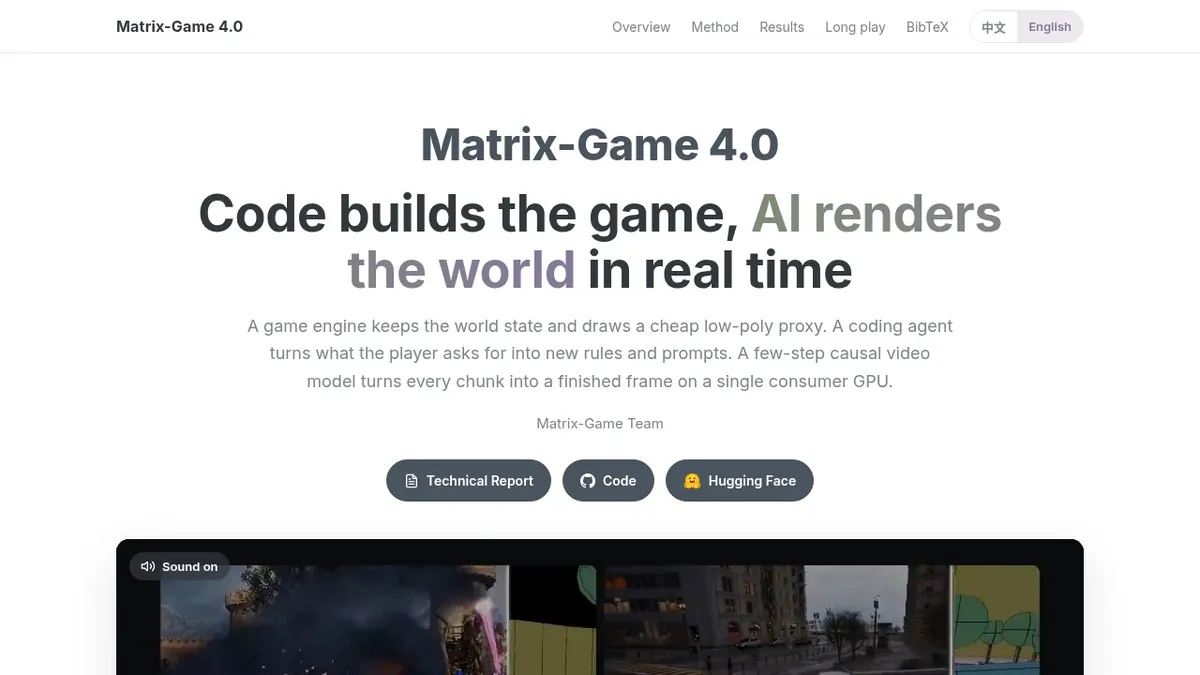
Skywork AI released Matrix-Game 4.0 on 15 October. It's the newest version of its open-source series of interactive world models. Earlier versions were world models that generated the whole picture. Version 4.0 splits the work. A normal game engine handles the rules, physics and player input, and draws a cheap low-poly picture of the scene. A causal video model then turns those low-poly frames into detailed visuals as you play. The team calls this "streaming neural rendering".
The project page adds a third part: a coding agent. It turns a player's request into new rules that are added to the engine, and it writes prompts from the current game state. Because the engine keeps the world state, things that leave the screen don't simply vanish.
The release includes inference code, a browser demo and the source of three sample games: Medieval Castle and Ancient Egypt, both third-person shooters, and City Racing, a driving game. The model weights and game assets are on Hugging Face. On 16 October the team added a technical report and optimised inference for RTX 5080 and 5070 Ti cards. Skywork quotes up to 67 FPS at 864 x 480 on an RTX 5080, counting model output only. The code is under the MIT licence.
Why it matters: This is a research project, not a production renderer. But keeping game logic in a real engine and using AI only for the look is a practical split, and you can run it and read the code yourself.
Source: Skywork AI on GitHub (official post, opens in a new tab)